SIZING SHARED CAMPUS WORKS / BLOG
Most campus budgets have two categories for shared works. The money is in the third.
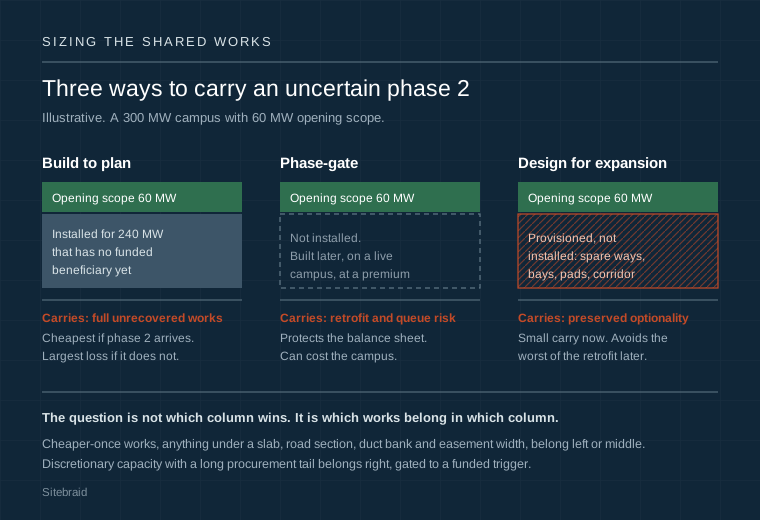
Build it all or build the minimum is a false choice. The works that are genuinely cheaper once, the works that can be provisioned rather than installed, and the works being built early because the plan said 300 MW are three different decisions, and most budgets treat them identically.
Current as of September 14, 2026. Cost figures are drawn from published transmission cost guides and are illustrative rather than a quotation for any campus. Revision log at the foot of this article.
Part of a five-article series on phased Texas data center campus development and the commitments sized to a buildout that may not arrive.
- Part one. The exposure: why a compliant tenant is the expensive one
- Part two. Where the exposure bites: security, tariffs, hedges and covenants
- Part three. Sizing the shared works against an uncertain phase 2
- Part four. Public commitments sized to full buildout
- Part five. Recovery once the phase has already stalled
The short version, for the capital committee.
| The false choice | Build to plan or phase-gate. Designing for expansion is a third column with different economics from either |
| Retrofit premium | Roughly $8M to $15M on a 240 MW increment. Substation equipment removal costs about what installation cost, so a bay added post-energization runs about twice the direct cost before outage windows |
| Preserved optionality | Roughly $2,000 to $6,000 per MW, or $500K to $1.5M on a 240 MW increment. An order of magnitude below either extreme |
| The ratio that decides it | MISO prices conduit at $3,562 material against $47,491 installation per 1,000 feet. Material is 7 percent of installed cost, flat across every voltage class |
| The constraint nobody models | Pavement cut moratoria on newly paved roads average five to seven years. Phase 2 trenching may not be expensive, it may be prohibited |
| The test | Not whether to build ahead. Which specific works are cheaper-once, which can be provisioned, and which are simply early |
The argument for phase-gating shared infrastructure is a balance sheet argument, and it is a good one. Capacity you build for a phase that never funds sits on your books earning nothing. A companion article, You underwrote the tenant's credit and the tenant's power, prices that exposure: on a 240 MW unrecovered position, an eighteen-month vacancy runs about $44 million of present value loss.
The development argument runs the other way, and it is not weak. This article makes it properly, because a piece that only argues one side produces advice from someone who has never rebuilt a live yard.
Retrofit is not the same cost, and sometimes not available at all
Trenching a second main down an occupied campus road, or returning to a substation site to add a bay once phase 1 is energized and under load, costs a multiple of doing it once. It also consumes outage windows you have to negotiate with a live tenant, and those are priced against real numbers. Uptime Institute's 2026 outage analysis reports that 57 percent of respondents' most recent significant outage cost more than $100,000, with one in five exceeding $1 million, and that failure to follow established procedures remains the leading driver of human-error outages, including errors during installation and commissioning. A tenant asked to accept a tie-in on live plant is being asked to accept the dominant cause of outages, on your schedule, for your benefit. Expect to pay for that or to be refused.
To attach a number: the MISO transmission cost estimation guide puts substation equipment removal at roughly the same cost as its original installation, so a bay added after energization carries approximately twice the direct cost before any outage window, congestion or safety premium is priced in. The retrofit premium on a duct bank run is almost entirely in the excavation, since the MISO table shows installation running at roughly 13 times material cost, so build-twice is approximately 26 times the conduit cost alone against build-once at 14 times.
On a 240 MW growth increment with modest duct bank runs, the difference between building once and rebuilding later commonly lands in the $8 million to $15 million range, varying with trench length and substation complexity. That is one to two years of the carry on an equivalent unrecovered position, which means phase-gating pays off only if the phase 2 slip extends past that window. Compute it explicitly before concluding that phase-gating protects the balance sheet.
The queue slot is a separate loss the retrofit math does not capture
An interconnection queue position took the longest to obtain and cannot be re-entered mid-cycle. Right-size the substation after phase 2 slips and a new study is required, and the re-entry point is behind whatever filed during the slip. In an ERCOT market where Batch Zero positions from the 2025 to 2026 filing windows are still working through study, the queue delay alone is commonly measured in years.
Value that slot at your own replacement cost: the carrying cost of the campus for the duration of the delay, plus any equity dilution or debt-cost change on a re-priced construction loan. On a 240 MW position in a tight market, the economic value of holding the slot is routinely more than the retrofit cost itself.
This is where the balance sheet framing misleads. The arithmetic in the companion article holds carry against a delay-damages claim, which is the right comparison for the lease. For the capital decision, the right comparison is carry against retrofit cost plus queue-slot loss, and the answer frequently inverts. A developer who phase-gates too aggressively can protect the balance sheet and lose the campus.
Optionality has value that does not appear in a carry calculation at all. Capacity you already hold is what lets you say yes to a tenant on their timeline rather than theirs plus a study cycle. In a market where power availability is the binding constraint, that is frequently the entire commercial proposition. Phase-gating everything converts a differentiated site into one that competes on price.
The third column
Designing for expansion means installing the opening scope while provisioning the route to the next one: spare ways and pull strings in the duct bank, a breaker position and foundation left open in the substation, transformer pads poured, pipe upsized rather than paralleled later, corridor and easement width taken while the land is cheap and the approvals are open.
Its economics are different from either extreme. The cost of preserved optionality on a 300 MW campus with 60 MW opening scope is not the carry from the first column. It is a premium on the base build: spare conduit ways in an open trench, a foundation pad for a future transformer, an easement platted wide enough to double the duct bank later. In practice that premium runs in the range of $2,000 to $6,000 per MW of reserved capacity, depending on how much of the provision is in the ground versus in the design drawings. Call it roughly $500,000 to $1.5 million on a 240 MW increment, against $10.1 million per year of full carry in the build-to-plan case or $8 to $15 million of retrofit in the phase-gate case.
That spread is why design for expansion wins most of the per-item analysis. You carry a small premium on the base build instead of the full cost of unused capacity, and you avoid the worst of the retrofit, because the expensive part of retrofitting a live campus is rarely the equipment. It is the trenching, the traffic control, the work around energized plant and the outage windows you have to buy from a tenant who has no reason to give them to you.
There is a published number that makes the point better than any estimate. MISO's transmission cost estimation guide prices conduit at $3,562 of material per 1,000 feet against $47,491 of installation, with installation defined to include the excavation and placement. Material is roughly seven percent of the installed cost, and the ratio holds flat across every voltage class in the table. Spare ways added to a trench that is already open capture the cheap part while the expensive part is already being paid for. Do it later, in a separate operation, and you buy the excavation twice.
The same guide supplies the other half of the argument. For any substation equipment that has to be removed, MISO uses that item's installation cost as the cost of removal. Rework is assumed to carry roughly twice the installation cost before anyone prices an outage window, a congestion cost or a safety premium on working near energized plant.
Two cautions on how far to take this
Preserved optionality is cheap at modest increments and stops being cheap quickly. Municipal oversizing credit schedules show the cost per linear foot of upsizing a water main rising steeply with diameter, and associated valve costs rising far faster than that. Provision generously, not infinitely.
Second, some of this is not a cost question at all. Federal highway guidance records pavement cut moratoria on newly paved roads averaging five to seven years. A campus that paves its roads in phase 1 may find phase 2 trenching is not expensive but prohibited, which is an argument for putting the duct bank in before the asphalt regardless of who funds the next phase. Sequencing constraints of that kind do not appear in any carry calculation and cannot be bought out later at any price.
The next action
The question to put to your development lead is not whether to build ahead. It is which specific works belong in which column.
Cheaper-once works. Anything under a slab, road section, duct bank, easement width. Build these to full campus sizing regardless of who funds phase 2, because the retrofit premium and the sequencing constraints both run against you.
Provisionable works. Spare ways, breaker positions, foundations, pads, upsized pipe. Install the opening scope and provision the route. This is where the recoverable money usually is, and it is the column most budgets do not have.
Discretionary capacity with a long procurement tail. Transformers, switchgear, anything with a lead time and a resale market. Gate these to a funded trigger rather than a stated plan.
Most campus budgets treat all three identically. Walk the single line and the civil drawings, mark every asset sized above phase 1 requirement, and assign each one to a column. The exercise takes an afternoon and it is the difference between oversizing with a named trigger and oversizing because the plan said 300 MW.
The practice to stop is not oversizing. It is oversizing with no named trigger, no priced option and no written answer to who carries the delta.
Take the work with you
The infrastructure responsibility matrix assigns control, funding, approval, construction, operation and acceptance across shared campus infrastructure, which is the register a column assignment is recorded in.
It is free, and it is in the resource library.
Revision log
September 14, 2026, revision 1. Initial publication. This article separates the sizing argument from the tenant-credit article, where it first appeared as a counterweight section, so the development case can be read on its own terms rather than as a rebuttal.
Sources
- MISO, Transmission Cost Estimation Guide for MTEP24, May 1, 2024, Table 2.3-12 conduit unit costs and Section 2.3 on removal cost. https://cdn.misoenergy.org/20240501%20PSC%20Item%2004%20MISO%20Transmission%20Cost%20Estimation%20Guide%20for%20MTEP24632680.pdf
- Federal Highway Administration, Pavement Utility Cuts, on degradation fees and paving moratoria. https://www.fhwa.dot.gov/utilities/utilitycuts/man03.cfm
- Uptime Institute, Annual Outage Analysis 2026, on outage cost distribution and procedural failure as a leading cause. https://uptimeinstitute.com/about-ui/press-releases/uptime-announces-annual-outage-analysis-report-2026
- ERCOT, Large Load Integration, forms and current process materials, on Batch Zero study timelines. https://www.ercot.com/services/rq/large-load-integration
- Sitebraid, "You underwrote the tenant's credit and the tenant's power. You did not underwrite the tenant's lender," on the carry and present value case for phase-gating. https://sitebraid.dev/blog/underwrite-the-tenants-lender/
- Sitebraid, "Future-ready capacity has a present-day bill," shared infrastructure funding campus challenge, reviewed September 10, 2026
This post is general business information compiled from public records. It is not project specific engineering, legal, tax, accounting or permitting advice. Illustrative figures are hypothetical and are not client results.