CAMPUS CAPITAL AND TENANT CREDIT / BLOG
You underwrote the tenant's credit and the tenant's power. You did not underwrite the tenant's lender.
A signed long-term offtake tells you the counterparty intends to pay. It does not tell you whether the capital that funds phases 2 through 4 still exists.
Current as of September 14, 2026. The PUCT Project 58481 rule discussed below is a Staff Recommended Adoption Order, not an adopted rule. Confirm the final text before acting on it. Revision log at the foot of this article.
The short version, for the capital committee.
| The exposure | A compliant tenant declines phase 2. Shared works sized for the full campus, no funded beneficiary, no breach to declare, no remedy |
| The number | On 240 MW of unrecovered works, an eighteen-month vacancy is about $44M of NPV loss and a three-year vacancy about $83M, against a delay-damages remedy of roughly $3.3M. The remedy covers 4 to 7 percent |
| What decides it | Vacancy duration, not the carry rate. The position relets, so this is a timing loss. How fast it relets depends on whether your pipeline is funded the same way as the tenant who just declined |
| No consent needed, 1 | Phase-gate the growth increment to a funded trigger rather than a stated plan |
| No consent needed, 2 | One number and one named party for who funds the phase 2 delta, before the increment is authorized |
| No consent needed, 3 | Re-run the no-expansion case with tenant slippage correlated rather than independent |
| What changed | The ERCOT phased-milestone trigger moved from six months to twenty-four, and the TSP retains 20 percent of the associated security rather than the 80 percent widely reported. The regulator will not surface a stalled phase on any timeline useful to you |
| If it already happened | The queue position cannot be sold on its own. ERCOT Planning Guide Section 9 has no transfer provision, unlike Section 5 for generators. Recovery is an entity sale or a relet, both slow |
| Check first | Your TSP tariff's non-utilization clause, which can recalculate CIAC on realized load, and whether any impact fee you have paid is refundable. Usually it is not |
Everything else below is negotiation.
The failure mode is rarely a default. It is a tenant that keeps paying and stops expanding.
A defaulting tenant gives you remedies, a claim, security and a reletting process. A tenant that performs on phase 1 and quietly declines phase 2 gives you none of those, and leaves you worse off, because the shared works you sized for the full campus stay on your balance sheet while the counterparty stays fully compliant. There is no breach to declare. Nothing triggers. Most campus documents are drafted heavily for the first case and lightly for the second.
Standard tenant diligence asks whether the counterparty is good for the rent and whether it has a credible path to power. Both are answerable. Neither answers the question that decides whether your oversized substation position ever gets a funded beneficiary: how is this tenant paying for its own buildout, and what has to stay true for that funding to continue. The answer is not in your lease file, and over the last two years it has moved somewhere your diligence does not reach.
The useful part is that much of the protection available here needs no counterparty agreement at all. You will not win a disclosure fight against a hyperscaler, so the sections below do not ask you to. What follows separates what you can impose on your own capital committee from what you have to negotiate, and what to do when they decline the negotiated part, which they often will.
What the financing evidence actually says
The Bank for International Settlements published Bulletin No 120, "Financing the AI boom: from cash flows to debt," by Iñaki Aldasoro, Sebastian Doerr and Daniel Rees, on 7 January 2026. Its key takeaways, quoted rather than paraphrased:
AI-related investment is surging both nominally and as a share of GDP, and currently accounts for a substantial share of economic growth. The size of anticipated investment needs will require firms to shift the source of financing from operating cash flows to debt, with private credit playing a rapidly increasing role. Macroeconomic and financial stability risks appear moderate, but the boom's sustainability hinges on AI firms meeting high earnings expectations. Equity prices have run far ahead of debt market pricing.
Risk is moderate, not acute. This is not a distress warning, it is a change in the source of financing, and the source determines how a counterparty's capacity to spend behaves when conditions move.
One number carries most of the weight for a landlord. In building its estimates the Bulletin adopts a figure from Noffsinger and co-authors, that data center equipment investment runs at roughly three times data center construction investment. Your tenant's invisible spend, the servers and the fit-out, is several times the visible building you are leasing them. That ratio is why the tenant's expansion decision is far more sensitive to credit conditions than their rent obligation is. Rent on a running hall is serviced from revenue. The next 60 MW of compute is serviced from a facility that has to be available and drawable at the moment the expansion option comes due. Those are different exposures, and only the first is underwritten in your file.
The BIS Quarterly Review of 14 September 2026 is a useful later marker: it described unease about valuations and possible overinvestment in the technology sector disrupting AI-driven equity momentum, while noting risk appetite proved resilient on the whole.
The mechanism, and why your diligence file cannot see it
When a tenant funded expansion from operating cash flow, counterparty analysis was reasonably complete. The entity signing the lease generated the cash, and the parent financials described the capacity to spend. Debt-funded expansion breaks that alignment. Capital is raised into structures beside the operating parent rather than inside it: special purpose entities holding a single campus or tranche of equipment, joint ventures with an infrastructure or financial sponsor, private credit facilities with covenant and drawdown mechanics, and operating leases that keep equipment commitments off the visible balance sheet of the entity you are looking at. These are ordinary financing choices. The landlord's problem is narrower: they are not visible in the documents tenant diligence conventionally collects.
So you can hold a signed long-term offtake from a creditworthy counterparty whose ability to perform on phases 2 through 4 depends on a financing chain you have never examined, cannot see in the signing entity's audited statements, and have no contractual right to be told about. Capacity to expand is not capacity to pay rent, and only the second is in your file.
The behavioral consequence, which is inference rather than a finding: when expansion is funded by drawn facilities rather than accumulated cash, its pace becomes sensitive to credit conditions in a way that rent on a running hall is not. Nothing about that predicts distress at any particular firm. It changes which of your tenant's obligations are robust and which are elastic, and the elastic one is the one your shared works are sized for.
Be honest about where this bites hardest, because it is not uniform. A top-tier hyperscaler funding expansion at a rated parent has visible debt, and your exposure there is real but bounded by disclosure you can actually read. The concern sharpens considerably for neoclouds, sponsor-backed developers and joint-venture vehicles, where the expansion capital sits at an entity with no public reporting obligation and the signing entity may be a matter of weeks old. A campus anchored by a rated hyperscaler and a campus anchored by a sponsor-backed operator are different underwriting problems wearing similar lease documents.
Where standard campus underwriting misses it
The standard discipline: a phase can be financeable as a building while the main, road or electrical work enabling it remains unfunded. So you run delayed occupancy and no further expansion through the same funding case, then establish who carries unused capacity, operations and any unrecovered advance.
It is incomplete in one respect. It treats "later phases may not arrive" as a risk to stress-test tenant by tenant. It does not ask whether the probability of arrival is correlated across your tenants.
Demand-side correlation is already standard in most funding cases. Correlation through a shared credit channel generally is not, and the financing shift is precisely that channel. If phases 2 through 4 are anchored to counterparties funding expansion from drawn facilities priced against the same set of AI earnings expectations, their delays are not independent draws. One condition moves several tenants at once, in the same direction, at roughly the same time.
You can test the magnitude this week without new data, using the no-further-expansion case you already run. It almost certainly assumes tenant slippage is independent. Re-run it with a shared factor driving the tenants funded through debt and see how far the simultaneous-slip scenario moves. It will not be a small move, and that second run is the one your lender is underwriting whether or not you have produced it. The full specification, tight enough to hand to an analyst without a follow-up meeting, is in the appendix below.
A practical screen: sort your anchor tenants by how they fund expansion, not by credit rating. Counterparties funding from operating cash flow, counterparties funding through corporate debt, and counterparties funding through project-level or sponsor vehicles are three different exposures. A campus anchored entirely in the third category is a concentrated position, no matter how strong each individual name looks.
What happens, in sequence
Trace the non-expansion case through a phased campus and it compounds in a specific order. Shared works here means every commitment sized to the full buildout: the substation and electrical backbone, yes, but also the water and wastewater supply contract and any reserved capacity in it, the Chapter 380 or 381 development agreement and any associated abatement, the carrier IRU, the land takedown schedule and the EPC guaranteed maximum price scope. The electrical position gets examined hardest. That is precisely why it is the least likely place to find an unmanaged exposure. The mechanisms below apply in order.
Oversized shared assets with no funded beneficiary. The substation position, main diameter and road section were specified for full-campus load. Phase 1 uses a fraction of the capacity and carries all of it. If phase 2 never funds, you hold a permanent asset sized for revenue with no committed source. No breach. Nothing triggers. The gap just sits there.
Posted security and CIAC sit against a ramp the tenant controls. Under ERCOT's Batch Zero process for large load interconnection, established through PGRR145 and NPRR1325 for loads of 75 MW and above and partially implemented on 11 July 2026, an interconnecting large load entity posts financial security tied to contracted peak demand. Planning Guide Section 9.2.1.1(1)(e)(vi) states that requirement as $50,000 per MW of peak demand, revised down from an earlier $100,000 per MW to track the PUCT's parallel work in Project 58481. On a 300 MW contracted position that is roughly $15 million at full contracted peak. That is refundable security, not a fee. Separately, SB6 provides for a flat transmission screening study fee of at least $100,000, which is a different and much smaller instrument. Do not model them as two per-MW charges. Establish early whether your security posts in full at commitment or phases against energization milestones, because it changes the exposure materially during the period that matters most, and phase 1 of a phased posting is a very different number from the headline.
Two things about that money matter more than the headline number, and both moved recently enough that anything written earlier in 2026 is out of date.
Cash CIAC for direct interconnection costs is not recoverable through regulated retail rates, so it does not come back. That part has been stable throughout.
The treatment of posted security on a missed phased energization milestone is the part that changed, and it changed in the developer's favor on both axes. The March 2026 proposed rule used a six-month miss as the trigger and was widely read as forfeiting the large majority of remaining security. Industry objected that transformer and long-lead equipment cycles alone run twelve to twenty-four months, so a six-month trigger penalized supply chains rather than speculation. Staff's Recommended Adoption Order in PUCT Project 58481, on which parties filed comments through 10 September 2026, sets the trigger at missing a phased milestone by twenty-four months, and on that miss applies security to outstanding amounts, has the TSP retain 20 percent of the security associated with the non-utilized transmission capacity, and returns the remaining balance to the customer.
Read that carefully, because it inverts the number that has been circulating. The 80 percent retained by the utility attaches to different circumstances in the schedule, including false information provided by a large load customer, which draws a 50 percent retention at the Batch Zero base tier. A twenty-four month milestone miss is not the same event and does not carry the same penalty.
It is a recommended adoption order rather than an adopted rule, so confirm the final text and its application to your specific request with interconnection counsel before the next capital release.
The direction of travel matters more than either number. A twenty-four month runway and a 20 percent retention is a materially softer regulatory backstop than the six-month, majority-forfeiture reading, which means the regulator is no longer doing much of your risk management for you. If the rule had held at six months, a tenant slowing its ramp would have hit a hard external wall that forced the conversation. At twenty-four months, a tenant whose credit facility tightened can slow the ramp well inside the grace period, and nothing external compels anything. You are still posting eight figures of security and non-recoverable CIAC against a ramp the tenant controls. The regulatory penalty that might have surfaced the problem for you has just been pushed out two years, which puts the burden back where this article started: in your lease file, where it is not.
The shared works are not just the substation, and the rest of them are worse. This article has used the electrical position throughout because it is the one campus teams examine hardest. That is precisely why it is the least likely place to find an unmanaged exposure. Apply the same phase 2 question to the commitments that get signed with less scrutiny and the picture sharpens considerably.
Impact fees are statutory and the asymmetry runs against you. Texas Local Government Code Section 395.025 lists when a political subdivision must refund an impact fee, and every trigger runs to the subdivision's failure to deliver. Nothing entitles a developer to a refund because its own later phases never arrived. Houston states plainly that water and wastewater impact fees are not refundable for any reason, including failure to complete the project, and Attorney General opinion GA-0797 found no refund requirement outside Section 395.025, specifically that a dormant project is not a trigger.
Two qualifications keep that in proportion. Collection under Section 395.016 is tied to plat recordation, connection or permit issuance, so a phase never built frequently never triggers the fee at all. And the largest recent Texas data center agreements negotiated these fees down or away, as Temple did. The exposure attaches to capacity you actually connected, not to capacity you drew on a plan.
One trap is worth knowing before you structure the land: Section 395.025(e) directs refunds to the record owner at the time the refund is paid, not to whoever paid the fee. If the land moves to a partner, a REIT or a tenant taking fee title, the refund right moves with it. Cheap to handle at the outset, impossible to fix later.
Reservation fees sit alongside impact fees rather than replacing them. Section 395.019(3) contemplates an owner voluntarily asking a provider to reserve capacity under a written agreement. In practice a developer pays impact fees for the units it connects and a separate annual fee on the living unit equivalents it is holding but not using, with unpaid reservation fees an event of default that ends reserved status. The impact fee buys capacity at connection. The reservation fee rents the option meanwhile, is expressly non-refundable, and can be forfeited on a fixed clock. Only one of the two usually appears in a capital plan.
On reserved water, the evidence cuts against the assumption this article started with. Some Texas providers do charge for held capacity: LCRA prices reserved firm water at exactly half the used rate indefinitely, and the West Travis County Public Utility Agency levies a non-refundable annual fee on unused living unit equivalents. But the executed data center agreements look nothing like that. El Paso Water's agreement with the Meta affiliate states the customer "shall not be obligated to use or take any portion of the Capacity Allocations, or to commence or complete construction of any portion of the Project," and bars reservation, capacity and impact fees by name. Temple's executed agreement for the Rowan project contains no take-or-pay, no reservation fee and no minimum monthly charge. Amarillo's agreement with Fermi obliges the developer to pay only for water actually taken.
Three agreements is a small sample and none of them is yours. The conclusion is not that reservation risk is absent, but that it is entirely a function of your specific tariff and agreement, and that the anchor tenants with the most leverage have been negotiating it away. If you are not that tenant, check whether your provider charges for unused capacity, because it is a real annual number that will not be obvious from the term sheet.
Public incentive agreements vary more than any other instrument here. Texas municipal practice treats a clawback as what keeps a Chapter 380 grant on the right side of the constitutional prohibition on gifts of public funds, and Chapter 312 requires recapture where an owner fails to make the improvements. Those provisions bite hard when drafted hard: Dallas's agreement with a Digital Realty entity makes recapture on a jobs shortfall equal to every dollar of abated tax from the start of the abatement period plus any grant already paid.
Do not assume yours reads that way. Across the executed Texas agreements the range runs from that full-benefit recapture to nothing at all. Equinix's Chapter 381 agreement with Dallas County provides that an event of default "shall not entitle County to reclaim or receive a repayment right with respect to any Tax Abatement for any year before the Event of Default occurs," with termination the county's sole remedy, "not damages or specific performance or any other remedy." A Hutto agreement recites a ten billion dollar investment as an intention, then states that nothing obliges the owner to construct any buildings and that failing to build them is not a breach.
Phase scoping is the pattern that matters most here, and it is close to universal. Temple's agreement for the Rowan campus states that although the company may develop in multiple phases over years, the agreement and all obligations "shall only apply to the Phase 1 Development." Read one way that is protective drafting, and it means the headline campus-wide investment number in a press release is almost never the enforceable commitment. Read the other way, the public incentive that made your pro forma work is scoped to phase 1 and shrinks alongside the buildout that is not arriving.
Most of these agreements label recapture as liquidated damages. Texas takes a retrospective look at whether the stipulated sum greatly exceeds actual harm and will strike it as a penalty where it does. That is a reason to negotiate a cap at signing, not a reason to assume a court will rescue you.
The clawback and the carry model are the same exposure, which is the part that gets missed. The carry table below includes a property tax line at 2.2 percent, and the reflexive objection is that an abatement removes it. Look at when the abatement is conditioned. If eligibility is tied to an investment or jobs number sized to the full buildout, the non-expansion case is the case where it lapses. The tax line does not just persist, it can arrive retroactively as recapture at the same moment the carry is running and the position is vacant. On an $84 million unrecovered position, losing a full abatement moves carry from roughly 9.8 percent to 12 percent, with recapture of prior years landing as a separate claim on top.
That is a compounding failure, not two independent ones. The tenant's decision not to expand triggers your shortfall against the public agreement, which raises the carry on the asset you are already holding vacant, in the period when your coverage ratio is worst. Check whether your eligibility thresholds are scoped to phase 1 or the full campus, and whether recapture reaches prior years or only the years in default. Temple and Equinix sit at the protective end of both. Dallas does not.
How the public and electrical exposures actually differ. Municipal exposure is mostly sunk and land-based: fees paid on capacity connected, assessments levied at full-buildout sizing, obligations that do not come back but frequently do not grow if you stop. Electrical exposure is forward-looking and capacity-based: security posted against contracted peak, non-recoverable CIAC, a non-utilization clause recalculating against realized load. In absolute dollars the electrical side is frequently larger. What the public commitments add is that the counterparty is often public so the remedy is statutory, the obligation is documented as a fee or covenant rather than an asset so it never surfaces in an oversizing review, and where a clawback has teeth it triggers on your own failure to reach a committed number. That last one is the only case in this article where a compliant non-expanding tenant puts you in default with somebody else.
One instrument deserves singling out, because it is the strongest failure-to-expand obligation in this survey and it sits on the developer rather than the tenant. A public improvement district assessment is levied against land sized to full buildout, is a first and prior lien, is a personal liability of the owner, runs with the land, and survives tax foreclosure as to installments not yet due. Offering documents say it directly: if the development cannot be completed as planned, the developer or a subsequent owner remains responsible for the full assessment. Texas MUD bond issuance works differently, gated by TCEQ on realized development with the developer reimbursed phase by phase, so the exposure there is front-loaded carrying cost rather than stranded public debt. But a district that stalls does not shrink its debt service, and a MUD's lien has priority over mortgages.
Your hedge may be sized to a campus you are not building. This one is two-sided, and the direction matters enough that getting it backwards would be worse than not raising it.
Construction lenders routinely require an interest rate hedge as a condition of closing, sized to projected drawdown. Covenants of the form "maintain Secured Hedge Agreements with coverage in a notional amount of not less than 50% of the outstanding principal amount of the Term Loans" are standard, and the notional schedule is set against the full facility. If phase 2 never funds, the hedge notional exceeds the drawn balance and you are paying fixed on money you never borrowed. Loan documents treat this as a defect to cure, typically capping notional at about 105 percent of outstanding principal and requiring you to unwind the excess. Hedge counterparties negotiate the mirror right, as Clifford Chance describes it, "a right to partially terminate the swap if the amount of the hedging exceeds a commercially agreed percentage of the outstanding debt."
Which way the unwind cuts depends entirely on rates, and right now it cuts in your favor. A pay-fixed swap gains value as rates rise. Medium-term Treasury yields are up roughly 100 basis points over the past year even with the Fed holding at 3.50 to 3.75 percent, so a developer terminating excess notional today is more likely receiving a payment than making one. The real cost of a stalled phase 2 here is the periodic drag of paying fixed on undrawn notional plus commitment fees on undrawn capacity, not a headline breakage loss. In a falling-rate environment the same mechanic reverses and becomes expensive.
The actionable detail is the instrument, not the forecast. Standard over-hedging covenants carve out caps expressly, on the logic that a cap cannot go against you the way a swap can. If your draw schedule depends on a phase you do not control, that carve-out is the reason caps are conventional for construction loans with uncertain draws. Hedging a lesser share of each anticipated draw does the same work. This is established project finance mechanics applied to a campus context rather than a documented campus phenomenon, so treat it as a question for your treasury function rather than a finding.
Your own utility agreement may already contain the clawback. This is the provision most campus teams have signed and not read. Oncor's Tariff for Retail Delivery Service, in the standard facilities extension agreement, carries a non-utilization clause: the CIAC you paid was calculated on estimated contract kW, and if within four years after Oncor completes the extension the load measured by actual maximum kW billing demand has not materialized, Oncor may recalculate the CIAC on the demand actually realized. The difference becomes a non-utilization charge, invoiced and payable within fifteen days.
Read that against the scenario in this article. A tenant that takes phase 1, performs perfectly and declines phase 2 produces exactly the fact pattern the clause is written for: an extension sized to a contract kW number the campus never reaches. The charge lands on you, not on the tenant, on a four-year clock you do not control, and it is separate from anything in the ERCOT security framework. Check your own TSP's tariff for the equivalent term and the term length before the next capital release.
Queue position sized to a buildout that may not fund. A queue position carries cost, is use-it-or-lose-it, and took longest to obtain. Right-size the substation after phase 2 slips and you do not get that position back on the same terms.
Lease terms survive the tenant's capital tightening, which cuts both ways. A long-term lease is enforceable against a tenant whose expansion capital has become expensive, protecting rent on the leased premises. It does nothing to compel an expansion option to be exercised, and an unexercised option on phases 2 through 4 is what the shared assets were sized for.
What your lender asks when phase 2 slips. At the first covenant test after the slip, the lender asks where reimbursement comes from, whether the phase 2 commitment is contractual or an option, and whether the borrower can service the oversized asset on phase 1 revenue alone. If the honest answer to the third is no, you have a refinancing event. Where the shared works sit in a dedicated entity, that event lands in a vehicle whose assets the operating neighbors depend on for service, and the campus has a single financial failure point even though the buildings are physically separate. Where common assets sit at the developer parent or inside the phase 1 entity, the exposure is real but differently placed. Know which structure you are in before the test, not during it.
Default versus non-expansion, side by side. The two cases are not variations of the same event. They differ on every dimension that matters to a recovery.
| Tenant defaults | Tenant performs, declines phase 2 | |
|---|---|---|
| Contractual trigger | Breach, with notice and cure | None. Nothing fires |
| Remedies available | Claim, security, termination, reletting | None against the unexercised option |
| Who holds the shared works | Recoverable through the claim and reletting | You, indefinitely |
| Counterparty status | Adverse, and you can act | Fully compliant, and you cannot |
| Typical drafting attention | Heavy | Light to absent |
The second column is the one that costs more, and it is the one most campus documents barely address.
Now the arithmetic, and it has to be a present value. Comparing an annual carry figure to a one-time damages claim is not a comparison, and an earlier version of this article made that mistake. A recurring cost and a single recovery are different objects. Put both in present value, net the residual, and the picture is worse than the ratio suggested, not better.
Work a hypothetical campus: 300 MW planned, phase 1 at 60 MW, shared works built for the full 300 MW at $350,000 per MW. The 240 MW of unrecovered capacity is about $84 million of substation position, main, road and backbone.
First, define carry properly, because 9 percent is the cost of capital and not the cost of holding the asset.
| Carry component | Rate | Annual on $84M |
|---|---|---|
| Cost of capital, blended debt and equity | 9.00% | $7,560,000 |
| Property tax, Texas ad valorem on real and personal property | 2.20% | $1,848,000 |
| Opex: substation O&M, right of way maintenance, inspection | 0.50% | $420,000 |
| Insurance, builders risk rolling to property | 0.30% | $252,000 |
| Full carry | 12.00% | $10,080,000 |
Carrying an oversized position at the cost of capital alone understates the annual number by about $2.5 million, a third of the way low. The property tax line deserves particular attention, because the obvious objection is that an abatement removes it. Sometimes. But a Chapter 312 or 380 abatement is commonly conditioned on the investment or jobs number tied to the buildout, which is precisely what is not arriving in this scenario. The non-expansion case is the case where the abatement is most likely to lapse or be recaptured. Run the tax line both ways and know which side of it you are on before you assume it away.
Now the loss, as a present value, discounted at the 9 percent cost of capital. The position is not worthless. In a tight ERCOT market an energized 240 MW position relets, so the honest exposure is the timing loss: carry borne during the vacancy, plus the revenue pushed out by it.
| Vacancy before relet | PV of carry | PV of deferred revenue | NPV of loss |
|---|---|---|---|
| 12 months | $9.6M | $20.6M | $30.1M |
| 18 months | $14.0M | $30.2M | $44.2M |
| 3 years | $26.4M | $56.7M | $83.1M |
| 4 years | $33.7M | $72.6M | $106.3M |
Against that, the remedy. Delay damages on phase 2 are typically liquidated and capped at a few months of the unbuilt phase's rent. At $110 per kW-year on a 60 MW phase 2, a six-month cap is about $3.3 million. At $150 it is $4.5 million.
So at an eighteen-month vacancy the remedy covers about 7 percent of the loss. At three years it covers about 4 percent. The ratio is not 2.3 times. Properly computed it is thirteen to twenty-five times, and the earlier figure was low because it compared one year of carry to the whole claim while ignoring deferred revenue entirely.
Two things that table does not include, both of which should be run separately rather than buried in the headline. If the relet happens at a permanent discount rather than at the same rent, add the present value of that haircut: a 15 percent haircut over twenty years is about $37 million on top. And if the position does not relet at all, the loss approaches the full capital plus carry, which is the scenario that ends campuses rather than bruising them.
The correlation question and the relet question are the same question. Every row in that table is driven by the vacancy duration, and vacancy duration is driven by how many plausible takers are funded the same way as the tenant who just declined. That is why funding-type concentration in your leasing pipeline drives this loss more than any lease term does.
One more thing about the $350,000 per MW. It is partly your decision, not purely an input, because you choose how much to oversize. Every figure here is computed at full-campus sizing, the most exposed end of the range. Phase-gating moves you down that axis. So does designing for expansion, at a fraction of the cost, which the later section prices.
Every figure above is hypothetical, chosen to show shape rather than to price a campus. The input to substitute first is vacancy duration, because the table is far more sensitive to it than to the carry rate: moving carry from 9 percent to 12 percent changes the three-year loss by about 6 percent, while moving the vacancy from eighteen months to three years nearly doubles it. Most underwriting spends its energy on the wrong one of those two.
Do not ask for the structure. Diagnose it from where they fight.
Requesting financing-structure disclosure at LOI does not work. You are one of several sites in a competitive process, the counterparty's real estate team cannot authorize disclosure of group capital structure, and the question reads as a signal that you will be difficult. Refusal is also not information, because everyone refuses.
Ask instead for terms whose cost depends on the structure: a parent guarantee on the expansion option, a requirement that the expansion commitment sit at the same entity as the phase 1 lease, and a capacity reservation deposit against reserved megawatts. Each reaches past the signing entity into whatever holds the expansion capital.
Then read the counter-offer, and nothing else. A letter of credit proposed in place of a parent guarantee, or a commitment offered at a named affiliate rather than the signing entity, is the counterparty showing you the relevant part of its entity chart in order to close. A counter-offer costs something to make and its content is a balance-sheet fact.
Timing tells you nothing. Escalation is the base rate for any non-standard term with a large counterparty and is routinely produced by approval calendars and tax counsel review. A clean balance sheet behind a slow treasury function looks identical to a complicated structure. Do not read it.
Attach the decision before you have the answer, so you are not negotiating with yourself afterward. Rated parent that signed: size the growth increment closer to the stated plan. Sponsor vehicle, joint venture or an entity you cannot see through: build phase 1 plus the smallest sensible increment, hold the rest at design and permit stage, price the reservation so the option carries itself. On a 300 MW campus the difference between those two postures is tens of millions of dollars of timing.
One note on counterparty type, because it inverts the whole approach. The indirect method above is a workaround for a top-tier hyperscaler where your leverage is thin. Against a neocloud or sponsor-backed operator, which is where this risk actually concentrates, you are frequently one of few sites that can deliver the power and a parent or sponsor guarantee is a live commercial ask. Ask directly there.
What you can require without anyone's consent
Phase-gate infrastructure sizing to the funding, not the plan. Separate minimum opening-phase scope from growth capacity, then attach the growth increment to a verifiable trigger: an exercised expansion option with a deposit, a funded CIAC contribution, or a take-or-pay on capacity rather than space. Oversizing is still frequently correct, and the next section makes that case properly. Oversizing with no named trigger is the specific practice to stop.
Answer on paper who funds the delta if phase 2 never arrives. One number, one named party. If your capital committee cannot produce both before the growth increment is authorized, it is not ready for approval. It is also the cheapest thing here to put in place.
Re-run the no-expansion case with correlated slippage. Your current case almost certainly assumes independence. The specification is in the appendix.
Use your own lender as the negotiating position. "I would like to understand your capital structure" is a preference a counterparty can decline. "My construction lender requires a named funding source for the growth increment before it will fund shared works" is a condition, and it is usually true. Have the conversation with your lender first and let their covenant requirements set the frame. It converts an awkward request into a constraint neither side controls. Use it once and hold it. Concede the point after invoking your lender and you have taught the counterparty that your lender is decorative.
Hold the evidence. The entity chart showing which party would hold expansion capital. The expansion trigger and its verification mechanism. The capacity-release provision mapped to the applicable utility milestone. The no-further-expansion case run with correlated slippage. A written record of who carries unused capacity, operations and any unrecovered advance.
The case against everything above
Everything to this point is written from the balance sheet. The development argument runs the other way, and it is not weak.
Retrofit is not the same cost, and sometimes not available at all. Trenching a second main down an occupied campus road, or returning to a substation site to add a bay once phase 1 is energized and under load, costs a multiple of doing it once. It also consumes outage windows you have to negotiate with a live tenant, and those are priced against real numbers. Uptime Institute's 2026 outage analysis reports that 57 percent of respondents' most recent significant outage cost more than $100,000, with one in five exceeding $1 million, and that failure to follow established procedures remains the leading driver of human-error outages, including errors during installation and commissioning. A tenant asked to accept a tie-in on live plant is being asked to accept the dominant cause of outages, on your schedule, for your benefit. Expect to pay for that or to be refused.
To attach a number: the MISO cost guide puts substation equipment removal at roughly the same cost as its original installation, so a bay added after energization carries approximately twice the direct cost before any outage window, congestion or safety premium is priced in. The retrofit premium on a duct bank run is almost entirely in the excavation, since the MISO table shows installation running at roughly 13 times material cost, so build-twice is approximately 26 times the conduit cost alone against build-once at 14 times. On a 240 MW growth increment with modest duct bank runs, the difference between building once and rebuilding later commonly lands in the $8 million to $15 million range, varying with trench length and substation complexity. That is one to two years of the carry from the arithmetic above, which means the phase-gate decision pays off only if the phase 2 slip extends past that window. It is worth computing explicitly for your campus before concluding that phase-gating protects the balance sheet.
The queue slot has a separate loss that the retrofit math does not capture. An interconnection queue position took the longest to obtain and cannot be re-entered mid-cycle. If the substation is right-sized after phase 2 slips and a new study is required, the re-entry point is behind whatever filed during the slip. In an ERCOT market where Batch Zero positions from the 2025 to 2026 filing windows are still working through study, the queue delay alone is commonly measured in years. Value that slot at your own replacement cost: the carrying cost of the campus for the duration of the delay, plus any equity dilution or debt-cost change on a re-priced construction loan. On a 240 MW position in a tight market, the economic value of holding that slot is routinely more than the retrofit cost itself. The arithmetic case for phase-gating in this article holds carry against a delay-damages claim. That is the right comparison for the lease. For the capital decision, the right comparison is carry against retrofit cost plus queue-slot loss, and the answer frequently inverts.
The premium for building it twice can exceed several years of the carry this article is warning about, and the comparison the arithmetic above makes is carry against a delay-damages claim, not carry against retrofit cost. On some works, particularly duct bank, road section and anything under a slab, building once is the only sane answer regardless of who funds phase 2.
Queue position is not a commodity you can reacquire. An interconnection slot took longest to obtain and does not come back on the same terms. Right-size the substation after phase 2 slips and you may be re-entering a batch cycle behind projects that did not blink. A developer who phase-gates too aggressively can protect the balance sheet and lose the campus.
Optionality has value that does not appear in a carry calculation. Capacity you already hold is what lets you say yes to a tenant on their timeline rather than theirs plus a study cycle. In a market where power availability is the binding constraint, that is frequently the entire commercial proposition. Phase-gating everything converts a differentiated site into one that competes on price.
And there is a middle path, which is where most of this should land. The article has been arguing as though the choice is build it all or build the minimum. It is not. Designing for expansion means installing the opening scope while provisioning the route to the next one: spare ways and pull strings in the duct bank, a breaker position and foundation left open in the substation, transformer pads poured, pipe upsized rather than paralleled later, corridor and easement width taken while the land is cheap and the approvals are open.
That is a real third column, and its economics are different from either extreme. The cost of preserved optionality on a 300 MW campus with 60 MW opening scope is not the carry from the first column. It is a premium on the base build: spare conduit ways in an open trench, a foundation pad for a future transformer, an easement platted wide enough to double the duct bank later. In practice that premium runs in the range of $2,000 to $6,000 per MW of reserved capacity, depending on how much of the provision is in the ground versus in the design drawings. Call it roughly $500,000 to $1.5 million on the 240 MW increment, against $10.1 million per year of full carry in the build-to-plan case or $8 to $15 million of retrofit in the phase-gate case. That spread is why design for expansion wins most of the per-item analysis. You carry a small premium on the base build instead of the full cost of unused capacity, and you avoid the worst of the retrofit, because the expensive part of retrofitting a live campus is rarely the equipment. It is the trenching, the traffic control, the work around energized plant and the outage windows you have to buy from a tenant who has no reason to give them to you.
There is a published number that makes the point better than any estimate. MISO's transmission cost estimation guide prices conduit at $3,562 of material per 1,000 feet against $47,491 of installation, with installation defined to include the excavation and placement. Material is roughly seven percent of the installed cost, and the ratio holds flat across every voltage class in the table. Spare ways added to a trench that is already open capture the cheap part while the expensive part is already being paid for. Do it later, in a separate operation, and you buy the excavation twice.
The same guide supplies the other half of the argument. For any substation equipment that has to be removed, MISO uses that item's installation cost as the cost of removal. Rework is assumed to carry roughly twice the installation cost before anyone prices an outage window, a congestion cost or a safety premium on working near energized plant.
Two cautions on how far to take this. First, preserved optionality is cheap at modest increments and stops being cheap quickly: municipal oversizing credit schedules show the cost per linear foot of upsizing a water main rising steeply with diameter, and associated valve costs rising far faster than that. Provision generously, not infinitely. Second, some of this is not a cost question at all. Federal highway guidance records pavement cut moratoria on newly paved roads averaging five to seven years. A campus that paves its roads in phase 1 may find phase 2 trenching is not expensive but prohibited, which is an argument for putting the duct bank in before the asphalt regardless of who funds the next phase.
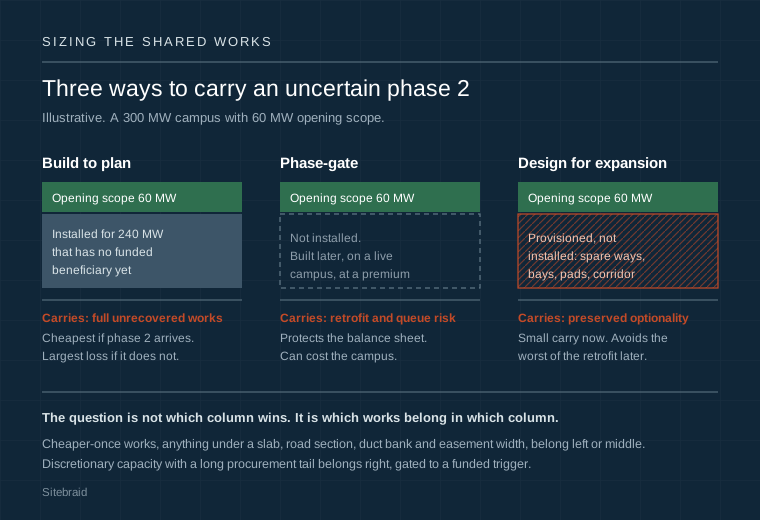
So the honest position is narrower than this article's own recommendation. Oversizing is often correct. The practice to stop is not oversizing, it is oversizing with no named trigger, no priced option and no written answer to who carries the delta.
The question to put to your development lead is not whether to build ahead. It is which specific works are genuinely cheaper-once, which can be provisioned rather than installed, and which are simply being built early because the plan said 300 MW. Three categories, not two. Most campus budgets treat all of them identically, and the middle one is where the recoverable money usually is.
What to negotiate, and what to do when they decline
Price the option the tenant holds. If phases 2 through 4 are optional, charge for the option. A capacity reservation fee, a standby charge on reserved megawatts, or a declining-balance CIAC credit each convert a free option into a priced one and produce cash while the beneficiary decides. This is the ask most likely to succeed, because it trades cleanly against headline rent. Expect to concede basis points on rent to win it, and treat that trade as the negotiation rather than a concession.
Build capacity-release mechanics before you need them. This is the most valuable term in this article and it deserves more than a sentence, so it gets its own section below.
Then assume they decline the rest. A hyperscaler anchor makes the campus, and walking away over a guarantee is rarely the right call. The protection then has to come from structure rather than contract.
Size shared works to a load you could relet rather than to the tenant's stated plan, and treat the difference between those two numbers as your actual speculative position. Stage utility commitments and CIAC so exposure accrues against milestones the tenant has funded rather than milestones it has forecast.
Then deal with funding-type concentration honestly. You do not select your phase 1 anchor's funding structure. On a 300 MW campus you take the counterparty that clears your lender's coverage test and arrives with a signed LOI, and in this market that is a short list, most of it funded the same way. Treating funding type as an anchor selection criterion is advice for a market that does not exist.
Where it becomes executable is phases 2 through 4, and as a priced constraint rather than a preference. Record your anchor's funding channel at signing. Carry it into the leasing plan for later phases as a concentration limit, the same way you would treat a single-industry tenant mix. Disclose it to your construction lender before they ask, because a lender who learns that all four phases depend on the same credit channel during a covenant test will price it far more harshly than one who was told at underwriting. Where you have any choice on phases 3 and 4, a colocation provider, an enterprise or a sovereign buyer whose capital is not priced off AI earnings expectations does more for your downside than a covenant you were going to lose in negotiation anyway.
This also reframes the lapse itself. In a tight interconnection market a released 240 MW position is not purely a loss, and reletting it to a different counterparty type can beat the original tenant exercising, because it breaks exactly the concentration described above. That is only true if you planned for it. Unplanned, the same event is the three-year vacancy row in the table above, and roughly $83 million.
If it already happened: what recovery actually looks like
Everything above is preventive. If your phase 2 has already gone quiet, the first instinct is to sell the interconnection position, and that instinct runs into a wall worth understanding before you spend legal fees on it.
There is no mechanism to sell a large load queue position on its own. ERCOT Planning Guide Section 9, which carries the Batch Zero rules, contains no transfer, assignment, change of ownership, novation or successor provision. That silence is structured rather than accidental. Section 5, governing generator interconnection, has express transfer machinery requiring notice to ERCOT within ten business days with documentary evidence of the ownership change. ERCOT knows how to write a transfer process. It wrote one for generators and did not write one for large loads.
Three provisions independently bind the position to your specific land and your specific end user. Site control under Section 9.2.1.1(1)(e)(viii) requires a lease, deed or executed purchase and sale agreement for identified parcels. The end-use nexus requires the entity to attest that it is the end user, or as a developer holds a binding contract of at least five years with one, which is the provision that stops a broker with no tenant. And changing the point of interconnection is a material change that triggers re-study, so a buyer cannot take the position to their own site. The attestations are sworn, notarized and entity-specific. They do not travel by assignment.
Note also what the statute does say. SB6 defines a large load customer to include "a successor in interest," which is a burden-following provision rather than a transfer-authorizing one. It exists so obligations cannot be shed by changing the name on the request. It makes a position less attractive to acquire, not more.
The absence of law firm commentary is itself evidence here. Across the client alerts published on SB6 and PGRR145 by the major energy practices, none treats the position as a tradeable asset. If a secondary market were a live structuring question, the energy M&A bar would be writing about it.
Texas built a public recapture channel where a private market would otherwise form. SB6 directs the commission to establish uniform requirements for when capacity subject to an outstanding financial commitment may be reallocated, and provides that security is refunded where capacity will be reallocated to other customers. The holder of a dead position gets a partial refund through an administrative process, not sale proceeds from a counterparty. That is the clearest signal that no secondary market is contemplated.
So the recovery paths that remain are narrower than the instinct suggests, and all of them keep the position attached to the project:
Sell the entity, not the position. An equity sale of the project company is the cleanest route, because the interconnecting entity remains the same legal person. No re-attestation is triggered and nothing needs ERCOT's consent. This is why data center site transactions are structured as entity acquisitions rather than asset sales.
Sell the land with the agreements assigned. Workable, but it requires the buyer to satisfy site control and the end-use nexus in their own right, which means they need a tenant. It is slower and the diligence is heavier.
Relet to a different counterparty type. The position keeps its value where a new end user takes service at the same location. This is the path the arithmetic above already models as vacancy duration, and it is the reason funding-type diversity in your leasing pipeline is worth more than it looks.
What none of these produce is a quick sale of a standalone asset. Plan recovery as an eighteen-month to three-year reletting problem with an entity-level exit as the alternative, and size the reserve accordingly. A developer who assumed the queue position could be liquidated on its own has mispriced the downside from the start.
The capacity release provision, in detail
If you win one negotiated term, win this one. It costs the counterparty nothing on their balance sheet, which is why it is gettable, and it is the only instrument that converts a silent stall into a dated decision.
A provision that actually works has six moving parts.
The trigger. Not a calendar date. Tie it to the event that creates your exposure: a missed funded-trigger date on the growth increment, or the utility milestone that puts your interconnection position at risk. A calendar date drifts with the project and gets amended. An external milestone does not.
The notice and cure. On trigger, written notice to the tenant with a defined window, commonly measured in weeks rather than months, to either exercise the expansion option, post the deposit that keeps it alive, or let it lapse. The cure has to have a price. A cure right that costs nothing is a free extension and the tenant will take it every time.
What lapses, and how much. Specify whether lapse releases the whole expansion block or a defined increment. Increment-based release is easier to negotiate and usually better for you, because it lets the tenant keep a realistic option while returning the capacity they were never going to take.
Your marketing rights on release. The provision must expressly permit you to market, reserve and lease the released capacity to a third party, including a competitor, without further consent. Tenants will try to make release consensual. A consent gate makes the whole clause decorative.
Tenant priority after release. This is what you concede to get the rest. A right of first offer on the released capacity for a defined period, or a most-favored pricing right if they re-take it within a window. It is genuinely valuable to them and costs you very little, because you keep the timing control that matters.
The utility and regulatory tie. Say explicitly what happens to the associated interconnection position, reserved water capacity and any public commitment when the block is released, including who bears any reallocation or reservation charge in the interim. This is the part most drafts omit, and it is the part that bites, because the capacity sitting on your balance sheet is frequently reserved with a third party under a separate contract that knows nothing about your lease.
On the clock: the twenty-four month ERCOT milestone makes this term more important, not less. A regulatory trigger that long will not surface a stalled phase on any timeline useful to you. Your own release mechanic is the only thing that will, and it is the reason to set your internal trigger well inside the regulatory one.
The next action
Not an analysis. A markup exercise your development lead can run this week.
Pull the single line and the civil drawings. Mark every asset sized above phase 1 requirement. Not the intent, the installed or committed capacity: conductor and transformer rating, duct bank ways, pipe diameter, road section, pad and foundation provision, easement width.
List every third-party commitment sized to the full campus, not just the electrical ones. The TSP agreement. The water and wastewater supply contract and any reserved capacity in it. The Chapter 380 or 381 development agreement and any abatement. The carrier IRU. The land takedown schedule. The EPC guaranteed maximum price scope. Each of these was negotiated against a buildout number, and each carries its own consequence if that number does not arrive.
For each line, record three fields. The release term, if one exists. The clawback or forfeiture on non-performance. And the date it becomes irreversible, meaning the point after which cancelling costs more than continuing.
Two lines will not be where you expect them. Your TSP's facilities extension agreement may contain a non-utilization clause with its own multi-year clock, and any impact fee already paid is almost certainly gone under Chapter 395 regardless of whether your phases arrive. Pull both before the meeting rather than during it.
Then compute carry. Do it last, deliberately. Carry is usually the smallest number on that page and always the easiest to fix, because it is yours alone and needs no counterparty. The clawbacks, the reserved-capacity charges and the irreversibility dates are the exposures that require someone else's agreement to change, which is why they need the longer lead time.
The page that comes back will not be balanced. Most campuses find the electrical position was examined carefully and the water contract, the development agreement and the takedown schedule were signed against the same optimistic buildout with nobody asking the phase 2 question at all.
Take the work with you
Three things in this article are worth doing this week, and two existing owner-side packs carry the underlying detail.
Run the NPV table at your own inputs. Substitute your vacancy assumption first, not your carry rate. The table is roughly four times more sensitive to how long the position sits than to what it costs to hold.
Pull your TSP's facilities extension agreement and find the non-utilization clause. Note the clock length and whether CIAC recalculates on realized load. The PUCT 58481 owner readiness pack covers financial security, CIAC, customer-built interconnection facilities and TSP takeover, which is where the posted security and non-recoverable CIAC in this piece are documented.
Check whether your development agreement's eligibility thresholds are scoped to phase 1 or the full campus. That single question determines whether a tenant's decision not to expand converts into your own default. The infrastructure responsibility matrix assigns control, funding, approval, construction, operation and acceptance across shared campus infrastructure, which is the register the phase 2 delta question is answered in.
Both packs are free, and both are in the resource library.
Appendix: the correlated slippage specification
For the analyst rather than the committee. This is the run described above, specified so it can be executed and defended without further instruction.
Keep the per-tenant slip probability already in your no-further-expansion case as the marginal. Run pairwise correlation among debt-funded anchors at 0.3, 0.5 and 0.7, and report the probability of three or more anchors slipping inside the same eighteen-month window. Hold the marginal fixed across the three runs and vary only the correlation. State N explicitly, since three of four anchors is a different claim than three of eight. Name the dependence structure, a one-factor Gaussian latent model being the usual choice.
Do not load every debt-funded anchor on the factor equally. This is the instruction most likely to be missed and it changes the answer. A rated hyperscaler drawing on a revolver and a sponsor-backed operator on a private credit facility are not exposed to the same tightening in the same degree. Either restrict the correlated block to the non-rated anchors, or run two loadings, a lower one for rated parents and a higher one for sponsor and project vehicles. Pairwise correlation alone does not pin down the joint tail, and your lender's analyst will pick a structure if you do not.
Two caveats to carry into the room with the output. There is no observable dataset of correlated campus phase slippage, so the ladder is a sensitivity and the finding is the shape of the curve, not a probability. Present it that way rather than defending a point estimate. And a Gaussian latent model is thin-tailed, which understates precisely the clustered outcome this exercise is testing for, so treat the result as a floor.
On the parameters: eighteen months is roughly the period over which a credit tightening transmits to capital plans, and three or more is where a campus funding case usually breaks rather than bends. Independent draws push that scenario toward negligible. Correlation in that range moves it into the range you have to size for.
Revision log
September 14, 2026, revision 4. Added a recovery section establishing that an ERCOT large load queue position has no standalone transfer mechanism, and that recovery runs through an entity sale or a relet. Added the hedge mismatch exposure, framed two-sided after checking the rate environment. Clarified that the $50,000 per MW figure is refundable security rather than a fee, distinct from the statutory flat study fee. Condensed the municipal and incentive material.
September 14, 2026, revision 3. Replaced the carry-to-remedy ratio with a present value comparison net of residual. The prior version compared one year of carry to the entire damages claim, which mismatched a recurring cost against a one-time recovery and ignored deferred revenue. The corrected figure is materially larger, not smaller. Decomposed carry into cost of capital, property tax, opex and insurance, and flagged the abatement interaction on the tax line. Added retrofit premium, queue-slot loss and cost-of-preserved-optionality figures to the counterweight section. Condensed the counterparty diagnostic section to the counter-offer signal.
September 14, 2026, revision 2. Corrected the ERCOT phased-milestone trigger from six months to twenty-four, and corrected the security retention from 80 percent to 20 percent, both per Staff's Recommended Adoption Order in PUCT Project 58481. Added executed Chapter 380 and 381 agreement evidence on recapture range and phase scoping. Corrected an earlier claim that reserved water capacity generally carries a standing charge: the executed Texas data center agreements reviewed contain no take-or-pay.
September 14, 2026, revision 1. Initial publication.
Sources
- Bank for International Settlements, BIS Bulletin No 120, "Financing the AI boom: from cash flows to debt," Iñaki Aldasoro, Sebastian Doerr and Daniel Rees, 7 January 2026. https://www.bis.org/publications/bulletin-120-financing-ai-boom-cash-flows-debt.pdf
- Bank for International Settlements, BIS Quarterly Review, September 2026, published 14 September 2026. https://www.bis.org/publications/qr-202609
- ERCOT, Batch Zero process for large load interconnection, PGRR145 and NPRR1325. Partial implementation confirmed by ERCOT Market Notice M-B063026-01, effective 11 July 2026. https://www.ercot.com/mktrules/issues/PGRR145 and https://www.ercot.com/services/comm/mkt_notices/M-B063026-01
- ERCOT, Large Load Integration, forms and current process materials. https://www.ercot.com/services/rq/large-load-integration
- PUCT Project No. 58481, Rulemaking to Implement Large Load Interconnection Standards under PURA 37.0561 and 16 TAC 25.194. Staff's Recommended Adoption Order, with party comments filed through 10 September 2026 (Item 216), setting a twenty-four month phased-milestone trigger and TSP retention of 20 percent of security associated with non-utilized transmission capacity. https://interchange.puc.texas.gov/Search/Filings?ControlNumber=58481
- Eversheds Sutherland, "ERCOT Board of Directors approves PGRR 145, Batch Zero process while PUC rule on refundability of security deposits remains forthcoming," June 2026, on the pendency of the refundability rule
- Oncor Electric Delivery, Tariff for Retail Delivery Service, Section 6.3 agreements and forms, Article II non-utilization clause for standard delivery system facilities, effective June 1, 2026. https://www.oncor.com/content/dam/oncorwww/documents/about-us/regulatory/tariff-and-rate-schedules/Tariff%20for%20Retail%20Delivery%20Service.pdf
- Texas Local Government Code Chapter 395, Section 395.025, Refunds. https://tcss.legis.texas.gov/resources/LG/pdf/LG.395.pdf
- City of Houston, Impact Fee Administration, on non-refundability of water and wastewater impact fees. https://www.houstonpermittingcenter.org/infrastructure-development-services/impact-fee-administration
- Lower Colorado River Authority, firm water rates for water used and water reserved for future use. https://www.lcra.org/water/permits-contracts/water-supply-contracts/firm-water-use/
- MISO, Transmission Cost Estimation Guide for MTEP24, May 1, 2024, Table 2.3-12 conduit unit costs and Section 2.3 on removal cost. https://cdn.misoenergy.org/20240501%20PSC%20Item%2004%20MISO%20Transmission%20Cost%20Estimation%20Guide%20for%20MTEP24632680.pdf
- Federal Highway Administration, Pavement Utility Cuts, on degradation fees and paving moratoria. https://www.fhwa.dot.gov/utilities/utilitycuts/man03.cfm
- Uptime Institute, Annual Outage Analysis 2026, on outage cost distribution and procedural failure as a leading cause. https://uptimeinstitute.com/about-ui/press-releases/uptime-announces-annual-outage-analysis-report-2026
- The Nichols Firm PLLC for Texas Municipal League Economic Development, Chapter 380 economic development agreements and the constitutional basis for recapture provisions. https://tmleconomicdevelopment.org/wp-content/uploads/2020/12/1100-Chapter-380-Economic-Development-FINAL-113020.pdf
- Texas Attorney General Opinion GA-0797, January 21, 2010, on the limits of impact fee refund obligations under Chapter 395. https://www.texasattorneygeneral.gov/sites/default/files/opinion-files/opinion/2010/ga0797.pdf
- El Paso Water and Wurldwide LLC, executed water and wastewater service agreement, on capacity allocations and prohibited fees. https://www.epwater.org/ep-water/assets/files/meetings/57/item-01-wtr-swr-agrmt-wurldwide-llc.pdf
- City of Temple and Rowan Temple LLC, executed utility service agreement, on impact fees for water and wastewater service. https://cms9files.revize.com/templetx25/City%20Attorney/Data%20Center%20Development/Executed%20Utility%20Service%20Agreement%20Rowan%20Project%20Temple%20Kayak%20%281%29.pdf
- City of Amarillo and Fermi, Inc., executed water supply agreement. https://www.amarillo.gov/wp-content/uploads/2025/11/Fermi-America-Water-Supply-Agreement_10302025_accessible.pdf
- City of Dallas Chapter 380 grant and tax abatement agreement with a Digital Realty entity, recapture liability provisions, via the Texas Comptroller Chapter 380 agreement database. https://assets.comptroller.texas.gov/dat/ch380/0002259/0002259-Dallas.pdf
- West Travis County Public Utility Agency, Revised Rate Tariff, on water and wastewater capacity reservation fees for unused living unit equivalents. https://www.wtcpua.org/wp-content/uploads/WTCPUA-Revised-Rate-Tariff-071626-1.pdf
- Texas Local Government Code Chapter 372, Section 372.018, on the nature and survival of public improvement district assessment liens. https://tcss.legis.texas.gov/resources/LG/pdf/LG.372.pdf
- Dallas County and Equinix, executed Chapter 381 agreement, on the absence of a repayment right on default, via the Texas Comptroller economic development agreement database. https://assets.comptroller.texas.gov/dat/ch380/0003113/0003113-Dallas.pdf
- City of Temple and Green Data LLC, executed Chapter 380 agreement, Section 4.2 on future phases and Section 4.3 on the employment commitment. https://assets.comptroller.texas.gov/dat/ch380/0008087/0008087-Temple.pdf
- City of Hutto and Hutto Data Center Campus Power LLC, executed Chapter 380 agreement, Section 2.4 on buildings as conditions precedent. https://assets.comptroller.texas.gov/dat/ch380/0014278/0014278-Hutto.pdf
- ERCOT, Planning Guide, July 1, 2026 edition, Section 9 (Large Load Additions), including Section 9.2.1.1(1)(e) site control, end-use customer and financial security requirements, and Section 5.2.4(5) generator interconnection transfer provisions for contrast. https://www.ercot.com/files/docs/2026/06/18/July-1-2026-Planning-Guide.pdf
- ERCOT, Section 9.2.1.1(1)(e) Attestation Form, on the sworn and entity-specific nature of the attestation. https://www.ercot.com/files/docs/2026/06/05/ERCOT-Section-9.2.1.1-1-e-Attestation.pdf
- Texas Senate Bill 6, 89th Legislature, enrolled text, Utilities Code Section 37.0561, on successor in interest, reallocation of committed capacity and the flat transmission screening study fee. https://capitol.texas.gov/tlodocs/89R/billtext/html/SB00006F.htm
- ERCOT, Large Load Interconnection Process Questions and Answers, Rev. 12.15.25, on material change and re-study triggers. https://www.ercot.com/files/docs/2025/12/24/Large-Load-Interconnection-Process-Q-A.pdf
- Clifford Chance, "Hedging in real estate finance transactions: from caps to swaps," October 2023, on partial termination rights where hedging exceeds agreed percentage of outstanding debt. https://www.cliffordchance.com/content/dam/cliffordchance/briefings/2023/10/hedging-in-real-estate-finance-transactions-from-caps-to-swaps.pdf
- Hogan Lovells, "Project finance transactions: managing interest rate risk," on negotiated hedge percentages and forced unwind on partial repayment. https://www.hlc.com/~/media/hogan-lovells/pdf/2020-pdfs/2020_09_01_project_finance_transactions_managing_interest_rate_risk.pdf
- Board of Governors of the Federal Reserve System, FOMC statements, January 28, April 29 and July 29, 2026, maintaining the target range at 3-1/2 to 3-3/4 percent. https://www.federalreserve.gov/monetarypolicy/fomccalendars.htm
- Federal Reserve Bank of St. Louis, FRED series DGS2, DGS5 and DGS10, Treasury constant maturity yields, September 2025 to September 2026. https://fred.stlouisfed.org/series/DGS5
- Sitebraid, "A campus plan needs a funder, a provider and an enforceable route to service," campus capital and public infrastructure, reviewed September 10, 2026
- Sitebraid, "Future-ready capacity has a present-day bill," shared infrastructure funding campus challenge, reviewed September 10, 2026
This post is general business information compiled from public records. It is not project specific engineering, legal, tax, accounting or permitting advice, and it is not a substitute for counsel on lease drafting, financing structures or interconnection agreements. Illustrative figures are hypothetical and are not client results.